
The University of Mississippi Athletics
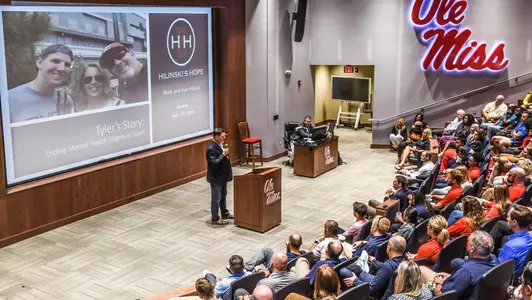
Hilinski's Hope Delivers Message of Mental Wellness at Ole Miss
9/19/2019 | Athletics
Mark and Kym Hilinski Speak with Ole Miss Athletics to Promote Mental Wellness
Washington State quarterback Tyler Hilinski already died once – on January 16, 2018, as the result of a self-inflicted gunshot wound – but now his family is making sure he doesn't die twice.
"Tyler's older brother Kelly has on his Twitter a quote - and he's had it for years, even before Tyler passed," Tyler's mother Kym said Wednesday on the Ole Miss campus. "'They say you die twice: once when you take your last breath, and once when someone says your name for the last time.' And Kelly just said, 'I'm not going to let my brother die twice.'"
Within days of Tyler's suicide, the Hilinski family decided that they would do everything in their power to prevent a similar situation from ever derailing another family. They've managed to do just that with the creation of Hilinski's Hope, their way of bringing awareness to mental health issues within the college athletics community.
"There were no signs," Kym said. "We didn't realize Tyler had any issues with his mental wellness. We came to believe he was most likely suffering in silence. It was unbelievable to us that he couldn't share that with us. We thought, 'We do not want another student-athlete, another person, to go through what Tyler must have been struggling with without being able to share that with anybody,' so that's why we formed Hilinski's Hope."
Mark and Kym Hilinski, the parents of Tyler, have been traveling the country for the past year and a half hoping to raise awareness and eradicate the stigma around mental health issues so that student-athletes just like Tyler can speak up and seek help.
This week, Mark and Kym made it to Oxford to speak with athletic staff, coaches, mental health professionals and student-athletes at Ole Miss. Next week, they'll be in another college town, speaking to a whole new group of college athletes. In each face, the Hilinskis say they see their late son. It's what motivates them to keep going, to keep professing Tyler's story so that no other parents are forced to endure what the Hilinskis have.
"It's been 20 months," Mark said. "It hasn't changed for me one bit from the day he left to now. It's as painful and unbelievable and tragic to me as it was that day. That keeps motivating us to use Hilinski's Hope as a tool to knock down the stigma around mental health."
Tyler never sought help, never opened up about the affliction that was raging inside his brain. He was sick, but nobody knew it – not his friends, not his teammates, not his brothers, nor even his parents.
There was perhaps one clue, something so small in passing it was only observable in retrospect, that Tyler's parents can look back upon and draw into their teachings today.
There was a friend of Tyler's who was straying from course in college, just finding himself getting in all sorts of trouble, whom Mark haphazardly chided for his imprudence. Tyler quickly came to his friend's defense with a passing remark of, "Hey Dad, you just never know what someone's going through." They didn't know it at the time, but now they wonder if that was his tiny, fractional way of saying, "I'm not doing well, either."
Now, as Mark and Kym travel the nation, they want to seek out those plagued by mental health issues and push them towards people who can help – the same help that Tyler never sought.
"If somebody had done this, talked to a team that Tyler was on, would he have sought help?" Mark said. "If you get up every day and choose to help people in his honor, like we're doing, that's the motivation you need to keep going."
There are two pillars to Hilinski's Hope: Step Up, a peer-to-peer bystander program training people to look for minor changes in their friends that may signal something more sinister; and Behind Happy Faces, a mental health curriculum designed for people suffering from mental illnesses.
In a setting like a football locker room, seeking help can sometimes feel difficult or overwhelming, but the Hilinski family wants to change the entire perception over mental health issues.
"Football players are strong," Kym said. "But you don't know what's really going on inside them. We know if they tore their ACL or have a broken arm, right, because we can see that. But you don't know if they're struggling mentally. We have to take more care with them."
Josie Nicholson, sport psychologist and counselor for Ole Miss Athletics, is trying to do just that – to take care of her athletes. But it starts with their friends and teammates, she said, and student-athletes as a community need to do a better job of looking out for one another.
"Get to know the person," Nicholson said. "They're more than their problems. They're more than their struggles. They're a son, a daughter, a sister, a brother, a pet owner, a dinosaur aficionado, whatever it is. If you can get to know the person, then that goes a long way in having them feel comfortable being vulnerable."
In college athletics, and football in particular, it can be difficult in getting athletes to find help, and so her mission entails first trying to eradicate the stigma behind mental health issues.
"Particularly for men's athletics, there is a culture of toughness," Nicholson said. "'Never admit you're weak. Never let them see you tired. Never show that you can't do it.' There's resistance to any sort of vulnerability. When we can't be vulnerable, then we are isolated."
Coaches preach toughness on a daily basis to their team, but Nicholson wants to spin what it means to be tough and carry over that mantra to her work.
"Being tough means doing the difficult things," Nicholson said. "And if it is difficult to ask for help, and it's easy to stay silent, then isn't it a sign of toughness to ask for help? Doing the hard thing, that's toughness."
This challenge rests not only on the shoulders of those struggling the most, but also on each and every student-athlete in the locker room, and in any community, for that matter. Some people, like Tyler, just can't find it in them to seek help. That's why the Hilinskis close every meeting by making their audience promise them one thing.
"Promise me you're going to take care of each other," Kym said. "It's a family. Be there for your family."
--
If you or someone you know is struggling with thoughts of suicide, please reach out to the National Suicide Prevention Lifeline 1-800-273-TALK (8255).
"Tyler's older brother Kelly has on his Twitter a quote - and he's had it for years, even before Tyler passed," Tyler's mother Kym said Wednesday on the Ole Miss campus. "'They say you die twice: once when you take your last breath, and once when someone says your name for the last time.' And Kelly just said, 'I'm not going to let my brother die twice.'"
Within days of Tyler's suicide, the Hilinski family decided that they would do everything in their power to prevent a similar situation from ever derailing another family. They've managed to do just that with the creation of Hilinski's Hope, their way of bringing awareness to mental health issues within the college athletics community.
"There were no signs," Kym said. "We didn't realize Tyler had any issues with his mental wellness. We came to believe he was most likely suffering in silence. It was unbelievable to us that he couldn't share that with us. We thought, 'We do not want another student-athlete, another person, to go through what Tyler must have been struggling with without being able to share that with anybody,' so that's why we formed Hilinski's Hope."
Mark and Kym Hilinski, the parents of Tyler, have been traveling the country for the past year and a half hoping to raise awareness and eradicate the stigma around mental health issues so that student-athletes just like Tyler can speak up and seek help.
This week, Mark and Kym made it to Oxford to speak with athletic staff, coaches, mental health professionals and student-athletes at Ole Miss. Next week, they'll be in another college town, speaking to a whole new group of college athletes. In each face, the Hilinskis say they see their late son. It's what motivates them to keep going, to keep professing Tyler's story so that no other parents are forced to endure what the Hilinskis have.
"It's been 20 months," Mark said. "It hasn't changed for me one bit from the day he left to now. It's as painful and unbelievable and tragic to me as it was that day. That keeps motivating us to use Hilinski's Hope as a tool to knock down the stigma around mental health."
Tyler never sought help, never opened up about the affliction that was raging inside his brain. He was sick, but nobody knew it – not his friends, not his teammates, not his brothers, nor even his parents.
There was perhaps one clue, something so small in passing it was only observable in retrospect, that Tyler's parents can look back upon and draw into their teachings today.
There was a friend of Tyler's who was straying from course in college, just finding himself getting in all sorts of trouble, whom Mark haphazardly chided for his imprudence. Tyler quickly came to his friend's defense with a passing remark of, "Hey Dad, you just never know what someone's going through." They didn't know it at the time, but now they wonder if that was his tiny, fractional way of saying, "I'm not doing well, either."
Now, as Mark and Kym travel the nation, they want to seek out those plagued by mental health issues and push them towards people who can help – the same help that Tyler never sought.
"If somebody had done this, talked to a team that Tyler was on, would he have sought help?" Mark said. "If you get up every day and choose to help people in his honor, like we're doing, that's the motivation you need to keep going."
There are two pillars to Hilinski's Hope: Step Up, a peer-to-peer bystander program training people to look for minor changes in their friends that may signal something more sinister; and Behind Happy Faces, a mental health curriculum designed for people suffering from mental illnesses.
In a setting like a football locker room, seeking help can sometimes feel difficult or overwhelming, but the Hilinski family wants to change the entire perception over mental health issues.
"Football players are strong," Kym said. "But you don't know what's really going on inside them. We know if they tore their ACL or have a broken arm, right, because we can see that. But you don't know if they're struggling mentally. We have to take more care with them."
Josie Nicholson, sport psychologist and counselor for Ole Miss Athletics, is trying to do just that – to take care of her athletes. But it starts with their friends and teammates, she said, and student-athletes as a community need to do a better job of looking out for one another.
"Get to know the person," Nicholson said. "They're more than their problems. They're more than their struggles. They're a son, a daughter, a sister, a brother, a pet owner, a dinosaur aficionado, whatever it is. If you can get to know the person, then that goes a long way in having them feel comfortable being vulnerable."
In college athletics, and football in particular, it can be difficult in getting athletes to find help, and so her mission entails first trying to eradicate the stigma behind mental health issues.
"Particularly for men's athletics, there is a culture of toughness," Nicholson said. "'Never admit you're weak. Never let them see you tired. Never show that you can't do it.' There's resistance to any sort of vulnerability. When we can't be vulnerable, then we are isolated."
Coaches preach toughness on a daily basis to their team, but Nicholson wants to spin what it means to be tough and carry over that mantra to her work.
"Being tough means doing the difficult things," Nicholson said. "And if it is difficult to ask for help, and it's easy to stay silent, then isn't it a sign of toughness to ask for help? Doing the hard thing, that's toughness."
This challenge rests not only on the shoulders of those struggling the most, but also on each and every student-athlete in the locker room, and in any community, for that matter. Some people, like Tyler, just can't find it in them to seek help. That's why the Hilinskis close every meeting by making their audience promise them one thing.
"Promise me you're going to take care of each other," Kym said. "It's a family. Be there for your family."
--
If you or someone you know is struggling with thoughts of suicide, please reach out to the National Suicide Prevention Lifeline 1-800-273-TALK (8255).




2025 Ole Miss Celebrity Softball Game (Presented by RiverLand)
Thursday, June 05
Will Allen Wins 2025 Funky's Ole Miss Softball Celebrity Home Run Derby
Thursday, June 05
NGWSD '25 Video
Wednesday, February 05
RebTalk (1-23-2025)
Thursday, January 23