.png&width=32&height=32&type=webp)


The University of Mississippi Athletics
Inside Look At Football Scheduling
9/28/2010 | Football
Sept. 28, 2010
On the surface, building the Ole Miss football schedule can seem like a simple task, but in reality, there are several factors that give the process some complexity.
First, we'll define the terms used in the scheduling process:
Guarantee Games: games that are normally one-time deals in which the home team pays the visiting team a sum of money for traveling to play the game.
Home & Home Series: a two-game contract to play one game at each of the respective schools' home stadium. There is either no money or equal money exchanged between institutions for these games. When there is an exchange, normally the home team will pay an amount to the visiting team to help cover travel expenses.
Neutral Site Game:a one-game event, normally put on by a third party, that matches two teams in a stadium that is neither team's home field. Typically both teams are paid a guaranteed sum of money to participate in the game, in exchange for a commitment to sell a certain number of tickets to the game.
Buyout: most all football game contracts now contain a large dollar buyout that any school that opts out of a game has to pay the other school.
So, where do we start with scheduling?
We make sure to have seven home games and one away game with another BCS-conference team or other notable opponent. Each year, as an SEC school, we always have four SEC home games and four SEC away games. That leaves three non-conference home games and one non-conference away game. So in any given year, we will have either two or three guarantee games at home depending on whether or not the BCS/notable opponent game is home or away.
One of the guarantee games will usually be a Football Championship Series (FCS) team. One FCS game can be counted each year toward the six wins needed to become "bowl eligible."
How do we choose those non-conference opponents?
Our non-conference schedule is based on several factors:
· Existing conference schedule - We have a tentative SEC schedule through 2016. Therefore, we first look at possible playing dates around our conference schedule. There will always be at least one, and in some seasons, two open dates during the season. We also try to avoid, where possible, having three or four weeks in a row of opponents that are perennial Top-10 teams. In situations where we schedule games in future years beyond when we have the SEC schedule, we will either schedule the date (and give it to the SEC Office to schedule around us), or we make the date TBA until the SEC schedule is given to us.
· Compatible dates - We contact several institutions about the possibility of playing us in football. If there is an expressed interest, we look for compatible dates on both team's schedule.
· Financial consideration - This is the most complex factor. Many of the smaller Division I Athletics programs use football guarantee games to balance their budgets. Because of this practice, these institutions will often leverage guarantee offers against one another in an effort to hold out for the highest bid. This has caused some institutions to pay as much as $1.3 million for a guarantee game. Because our football ticket revenues are only 50-60 percent of some of the institutions we are "bidding" against for these guarantee game opponents, we have to be creative in our approach. A prime example of this is our deal with Fresno State, which is a three-game series in which two are here in Oxford (last weekend and 2015) and one is in Fresno (next year). We pay them $210,000 for coming here this year; they pay us $250,000 to go out there next year; and, we pay them $400,000 to come here in 2015. The net-net of that is we have a home & home series with them and pay them $360,000 for the third game. There are very few matchups in today's market where a non-BCS Division I team goes to a BCS opponent to play for that small of a guarantee.
· Keeping matchups interesting - We resist consecutive home & home series with the same opponent and look for opportunities for neutral site games (season opener) with a BCS opponent (maybe once every five years or so).
Other frequently asked questions…
Why is a BCS Conference opponent or notable game important?
· - Helps sustain a strong season ticket base.
· - Creates interest for Ole Miss football regionally and nationally, both for fans and recruits.
· - Gives our fans the opportunity to visit other campuses.
· - HHHhhHelps our television partners, CBS and ESPN, attract strong viewership and ratings.
What about those neutral site games?
Occasionally, due to scheduling, we may have our seven home games accounted for and have the opportunity to play a "Made for Television" game at a neutral site. In the future we will see neutral site games played in Atlanta, Dallas, New Orleans, Orlando and other destination points. If the opponent and the location would be something our fans would enjoy, we would try to make the situation work. In the interest of full disclosure, the organizers of such events are willing to guarantee a substantial payday.
Why are seven home games important?
We have over 6,000 priority seat donors that represent almost 29,000 seats including club seats and suites. That represents almost $11 million in annual donations. Part of the value of those seats and suites is the expectation of seven home games.
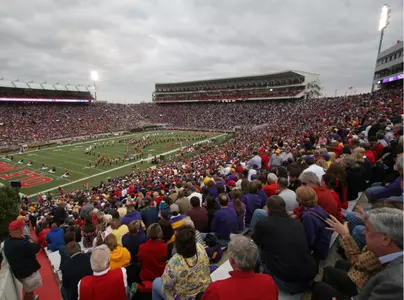
Every home game is an opportunity to reunite our fans and alumni as well as sell our university to prospective students and student athletes. Additionally, each year we are seeing the Ole Miss football game day atmosphere as a "must see" destination point for avid college football fans.
Where do the officials come from?
· For Guarantee Games, the team paying the guarantee uses their conference's officials.
· Officials in Home & Home Seriesare determined when contracts are done, and both institutions agree to use their respective conference's officials either at home or on the road. Moreover, the majority of teams want their own conference's officials on the road because it could be perceived as a way to reduce home field advantage.
· For most games played at a Neutral Site, a neutral officiating crew is used. For example, if an SEC team plays an ACC Team, officials would come from the Big 10 or Big 12. Bowl games are similar.