
The University of Mississippi Athletics
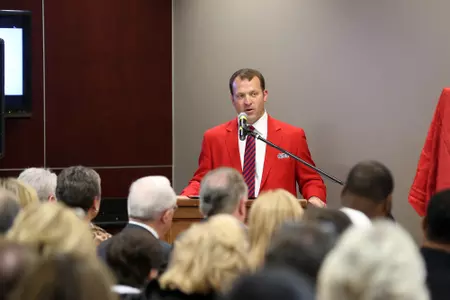
State of the Program
4/14/2015 | Athletics
April 14, 2015 By Austin Miller, OleMissSports.com
OXFORD, Miss. -- Nearing the end of another semester and ahead of the fourth annual BancorpSouth Rebel Road Trip, I sat down with Athletics Director Ross Bjork to discuss the state of the Ole Miss athletics program.
Austin Miller: It's been quite the calendar year in Ole Miss sports. For you in your interactions with coaches, student-athletes and fans, what has been the most rewarding part of that success?
Ross Bjork: The most gratifying thing is really seeing the smiles on the faces of everyone involved, the student-athletes, the coaches, the athletic trainers, the strength coaches, who are behind the scenes preparing our athletes, and of course, our fans, who have seen that we can do it.
That's the biggest thing. Everything that's happened provides examples and provided the foundation that says that we can do it. Since we have all gotten here, we have been saying why not Ole Miss? Let's figure out where our ceiling is, and only we can define that. These examples of success give us a platform to say we can do it and compete on the biggest stages in college athletics.
Now, we have to continue that and continue to build on it and take the next step. We reached a certain level. Now, we have to take that next step. That will be our challenge, our goal and our vision moving forward.
AM: Ole Miss has been on a lot of big stages. What has that prominence done for the Ole Miss brand, and where do you see the benefits from that exposure?
RB: There are some tangible things. Our licensing revenue is up 46 percent over last year, and we're not even through the fiscal year. Our fundraising is up $4 million year to date, from April 9, 2014, to April 9, 2015. We sold our second-most baseball season tickets. Our campaign is thriving right now.
Applications and admissions are up on campus. Even though it's hard to quantify a direct correlation between athletics success and applications, they're both up. We believe there is some correlation there, so we're seeing a lot of trend lines heading in the right direction. We can point to a lot of tangible evidence that things are headed in the right direction because of athletics. We have to keep that in perspective and keep growing.
And then there's the emotional confidence that is hard to see on paper, but people walk prouder. They're more confident in the athletics leadership. We have both tangible and intangible things that we can point to that says we're on the right track. Now, we have to keep moving.
AM: What is the latest with the Forward Together capital campaign? And when do you anticipate reaching the $150 million goal?
RB: We're just over $132 million raised in our Forward Together campaign. We have about eight months left in the calendar year, and by the end of the calendar year, we feel like we can close out the $150 million mark. That's our goal. We're having conversations that will get us to that point. We have a lot of substantial gifts in the pipeline. The donors see the finish line as well, and they would like to get us there. The $150 million mark is in sight.
Three years ago at this time, we were at about $62 million. Now, we're at $132 million. Over the course of the last years, we have raised about $70 million toward the campaign, and a lot of it has been philanthropic giving. We have tried to go out and secure outright gifts, to put names on a building or names on a room. There's a lot of great momentum there.
It's even more critical now to show support with what's happening on campus now that we have a change in leadership with our chancellor. Now is the time to give and support, if you believe in Ole Miss. And we'll keep sending that message.
AM: After the Forward Together capital campaign reaches the $150 million mark, what's next in the area of fundraising? What are the next challenges and the next projects?
RB: There's always next. We'll continue to raise money for our facilities. People really like giving toward facilities because they can see it. We'll go past the $150 million mark. We're still working to determine where the campaign ends up. Once we feel like we're in a good spot to fund all these projects, we'll determine if we raise it to $175 million or another mark. The university is in the quiet phase of a capital campaign, so we'll fold into that and maybe add a number into the university's campaign.
After facilities, the goal will be to increase our endowment. Right now, our endowment is nowhere close to where it needs to be. Endowment giving provides perpetual funding. It's a bank account that lasts forever. Right now, we have about $4 million in our endowment, and we need a $25-$50 million endowment for our program. Our goal will be to then go after endowment gifts that give us life-long funding in perpetuity.
AM: How does the cost of attendance and new NCAA Division I model factor into fundraising and the business side of Ole Miss Athletics?
RB: It all ties together. The more money we generate, the more financially stable we become. The cost of attendance will be a line item of about $1.3-1.4 million. To get back to the endowment model, if you can have that permanently funded, you don't have to worry about it. You can spend about five percent of your endowment, so we need about a $30 million endowment. That would be one threshold to reach.
Fortunately right now, we are in a great position with SEC Network and College Football Playoff money, as well as money we're generating in ticket sales and donations. All of our numbers are up, so we're able to cover cost of attendance and other things that may be increased. We have a plan for all of that, and we'll keep generating more to cover what's next in the future.
AM: What's the latest with all of the facility construction on campus? The parking garage, Vaught-Hemingway Stadium and The Pavilion at Ole Miss.
RB: They're coming along great. The Pavilion is the big one. In the fall, fans will see a cleaned-up north side of The Pavilion. It won't be quite ready, but fans will be able to access the west side of the football stadium between the stadium and The Pavilion. Those things will come together. Having the parking garage open will be a big asset.
Something fans really won't see will be a TV truck parking compound that was built adjacent to the parking garage below ground, where TV trucks can plug and play and be connected to the stadium and Pavilion. The practice fields will be re-developed and be ready by the summer.
The south end zone suites and club seating area is on track and will be ready for August. The west press box area will be done by August, and suite holders will have a better experience. The one thing that we had to wait on was the club lounge itself. We'll have the seats in place, but we won't have the lounge available for this year.
We had to readjust the bid. The original bid came double the budget, so we had to re-package and re-bid the suites, seating and concourse parts separately. We won't have the club lounge for this year, but we'll give people relief on their donations and things like that.
And then the north end zone and all the new video board components will go out to bid later this summer, and we'll start construction essentially as soon as the LSU game is over this fall. We'll start tearing down the south end zone to be ready for the start of the 2016 football season.
The next two years are crunch time for our projects. The campus will continue to evolve. We'll have to have patience around some of these things, but we'll try to minimize the disruptions and get these projects going.
AM: What kind of opening is planned for The Pavilion at Ole Miss?
RB: We are programming exactly how the opening will come together. In early January, we'll play our first SEC men's and women's basketball games in there. We're looking at the first couple of weeks of January to play those games, and then we're looking at an elongated celebration of that opening. There won't necessarily be one event that marks the opening. We really believe that we need to have several events that fit how that building will be served -- athletics, concerts, shows, speeches and graduation. We think we can do a lot of different things in there to celebrate the opening of that building, and those things are coming together as we speak.
AM: What's it like opening The Pavilion at Ole Miss with a lot of excitement surrounding both basketball programs going into next season?
RB: The building has helped momentum for both teams. Matt Insell has talked about all the positive vibes he has gotten on the recruiting trail. On the men's side, going to the NCAA Tournament and having a good nucleus coming back, but also having some key recruits and then there are some big-time recruits out there who are undecided.
We're creating a lot of momentum. We looked and said how a perfect world would play out, and it would be going into a new building with a lot of momentum with your programs, and you could capitalize on all that, and you could get people excited about buying tickets and committing to our campaigns. All of those things go hand in hand.
The success of the programs absolutely helps, and that's the key part about why we built the building where it is and why we're targeting students throughout the week and get them used to coming into The Pavilion. We want them to like the building, so that it's comfortable for them and they want to support our team. Our donors are comfortable and our fans are comfortable. Every seat is close to the court. There's not a bad seat in the building.
It all ties together in a grand vision that basketball can be and should be relevant on our campus, and we're investing the right kind of resources to make it relevant.
AM: Nearly eight months since its launch, what kind of impact has the SEC Network made?
RB: For all of us involved, the SEC Network has exceeded expectations. We did not believe we would be in a financial positive until the third year, and we will be in a financial positive in the first year. Those numbers are still being developed and we'll have all those final numbers in May at our meetings, so that's exceeded expectations.
The programming, branding and awareness have also exceeded expectation. You look at the amount of football and basketball programming. Our basketball game against Kentucky was a big-time, high-level game that got a lot of attention, so I believe they have exceeded expectations in being purposeful with their programming.
For me, personally as an athletics director, I love that when our team is on the road in the SEC, I can watch their games and I can see our teams compete. On the weekend, I have my iPad, iPhone and computer all going, if we have different things going on at the same time. From a fan-viewing standpoint, we have never been in that situation before.
AM: What do you expect to come out of the SEC Spring Meetings with a new commissioner and the new NCAA Division I model?
RB: There's going to be a lot of praise and celebration of commissioner Mike Slive and his leadership and what he provided to the conference throughout the spring and in Destin at our spring meetings. Everybody will prepare for the transition with Greg Sankey.
The great thing about Greg is he's already well-known within our league. He already has relationships, and he will come in with a fresh perspective and put his own stamp on our league. That will be good and healthy, and we'll adapt to those things as needed. He's meeting with every athletics director in our league in preparing for that transition. I'm excited about that. I think there will be some neat things that come with that.
In Destin, we'll be looking at cost of attendance and how people are adapting to that and looking at the model of how we pay out the cost of attendance to our student-athletes. We'll talk about the SEC Network, and where it goes and what's the next step. We'll talk about the transition of leadership with Greg. We're always going to talk about national legislature, such as transfer rules and an early signing period in football. And we'll talk about the continued evolution of basketball and how we'll get better.
Those are some of the things I will be paying attention and I think will be important during those meetings.
AM: What has Dan Jones meant to Ole Miss Athletics, and what's the challenge of this transition period with the search for a new chancellor?
RB: He's meant everything to where we are today. He brought us all together in 2012. He looked at Coach Freeze and myself. He led those transitions and brought us here. To me, he's the reason why we're in the position we are now. We owe him a lot of gratitude and praise for getting athletics to an important place, where we can have success and capitalize on the assets we do have. He put us in position.
Personally, you feel for him and his wife, Lydia. You're with them in thoughts and prayers as they go on to their next chapter. Now that we are in a final position, where the decision is final, our job will be to praise him. It's the right thing to do.
But then we also have to look to the transition and work with our leaders as the search for our new chancellor begins and be supportive in that process. We will continue to try and put athletics in a position where we can help make the entire university be attractive for new leadership.
One of the healthy things about athletics is we're visible and we can show a confidence for the entire university that will hopefully attract terrific leadership. Our wish in this entire process is to attract a leader that can understand the value of athletics while keeping it in perspective that we're not the most important thing, but continue to move the university forward academically and socially in a leadership position.
Hopefully that will be the profile that will be out there for the new leader, and we're going to support that transition and be here to help and provide an emotional confidence that will attract somebody that is really good. This place deserves it, and this place can do it. We believe the future is very bright for the entire university, and leadership is the key ingredient, so we have to identify the right leader.
Austin Miller is a writer and blogger for OleMissSports.com. He joined the staff in June 2013 after serving as sports editor of the Daily Mississippian. Follow him on Twitter @austinkmiller.
OXFORD, Miss. -- Nearing the end of another semester and ahead of the fourth annual BancorpSouth Rebel Road Trip, I sat down with Athletics Director Ross Bjork to discuss the state of the Ole Miss athletics program.
Austin Miller: It's been quite the calendar year in Ole Miss sports. For you in your interactions with coaches, student-athletes and fans, what has been the most rewarding part of that success?
Ross Bjork: The most gratifying thing is really seeing the smiles on the faces of everyone involved, the student-athletes, the coaches, the athletic trainers, the strength coaches, who are behind the scenes preparing our athletes, and of course, our fans, who have seen that we can do it.
That's the biggest thing. Everything that's happened provides examples and provided the foundation that says that we can do it. Since we have all gotten here, we have been saying why not Ole Miss? Let's figure out where our ceiling is, and only we can define that. These examples of success give us a platform to say we can do it and compete on the biggest stages in college athletics.
Now, we have to continue that and continue to build on it and take the next step. We reached a certain level. Now, we have to take that next step. That will be our challenge, our goal and our vision moving forward.
AM: Ole Miss has been on a lot of big stages. What has that prominence done for the Ole Miss brand, and where do you see the benefits from that exposure?
RB: There are some tangible things. Our licensing revenue is up 46 percent over last year, and we're not even through the fiscal year. Our fundraising is up $4 million year to date, from April 9, 2014, to April 9, 2015. We sold our second-most baseball season tickets. Our campaign is thriving right now.
Applications and admissions are up on campus. Even though it's hard to quantify a direct correlation between athletics success and applications, they're both up. We believe there is some correlation there, so we're seeing a lot of trend lines heading in the right direction. We can point to a lot of tangible evidence that things are headed in the right direction because of athletics. We have to keep that in perspective and keep growing.
And then there's the emotional confidence that is hard to see on paper, but people walk prouder. They're more confident in the athletics leadership. We have both tangible and intangible things that we can point to that says we're on the right track. Now, we have to keep moving.
AM: What is the latest with the Forward Together capital campaign? And when do you anticipate reaching the $150 million goal?
RB: We're just over $132 million raised in our Forward Together campaign. We have about eight months left in the calendar year, and by the end of the calendar year, we feel like we can close out the $150 million mark. That's our goal. We're having conversations that will get us to that point. We have a lot of substantial gifts in the pipeline. The donors see the finish line as well, and they would like to get us there. The $150 million mark is in sight.
Three years ago at this time, we were at about $62 million. Now, we're at $132 million. Over the course of the last years, we have raised about $70 million toward the campaign, and a lot of it has been philanthropic giving. We have tried to go out and secure outright gifts, to put names on a building or names on a room. There's a lot of great momentum there.
It's even more critical now to show support with what's happening on campus now that we have a change in leadership with our chancellor. Now is the time to give and support, if you believe in Ole Miss. And we'll keep sending that message.
AM: After the Forward Together capital campaign reaches the $150 million mark, what's next in the area of fundraising? What are the next challenges and the next projects?
RB: There's always next. We'll continue to raise money for our facilities. People really like giving toward facilities because they can see it. We'll go past the $150 million mark. We're still working to determine where the campaign ends up. Once we feel like we're in a good spot to fund all these projects, we'll determine if we raise it to $175 million or another mark. The university is in the quiet phase of a capital campaign, so we'll fold into that and maybe add a number into the university's campaign.
After facilities, the goal will be to increase our endowment. Right now, our endowment is nowhere close to where it needs to be. Endowment giving provides perpetual funding. It's a bank account that lasts forever. Right now, we have about $4 million in our endowment, and we need a $25-$50 million endowment for our program. Our goal will be to then go after endowment gifts that give us life-long funding in perpetuity.
AM: How does the cost of attendance and new NCAA Division I model factor into fundraising and the business side of Ole Miss Athletics?
RB: It all ties together. The more money we generate, the more financially stable we become. The cost of attendance will be a line item of about $1.3-1.4 million. To get back to the endowment model, if you can have that permanently funded, you don't have to worry about it. You can spend about five percent of your endowment, so we need about a $30 million endowment. That would be one threshold to reach.
Fortunately right now, we are in a great position with SEC Network and College Football Playoff money, as well as money we're generating in ticket sales and donations. All of our numbers are up, so we're able to cover cost of attendance and other things that may be increased. We have a plan for all of that, and we'll keep generating more to cover what's next in the future.
AM: What's the latest with all of the facility construction on campus? The parking garage, Vaught-Hemingway Stadium and The Pavilion at Ole Miss.
RB: They're coming along great. The Pavilion is the big one. In the fall, fans will see a cleaned-up north side of The Pavilion. It won't be quite ready, but fans will be able to access the west side of the football stadium between the stadium and The Pavilion. Those things will come together. Having the parking garage open will be a big asset.
Something fans really won't see will be a TV truck parking compound that was built adjacent to the parking garage below ground, where TV trucks can plug and play and be connected to the stadium and Pavilion. The practice fields will be re-developed and be ready by the summer.
The south end zone suites and club seating area is on track and will be ready for August. The west press box area will be done by August, and suite holders will have a better experience. The one thing that we had to wait on was the club lounge itself. We'll have the seats in place, but we won't have the lounge available for this year.
We had to readjust the bid. The original bid came double the budget, so we had to re-package and re-bid the suites, seating and concourse parts separately. We won't have the club lounge for this year, but we'll give people relief on their donations and things like that.
And then the north end zone and all the new video board components will go out to bid later this summer, and we'll start construction essentially as soon as the LSU game is over this fall. We'll start tearing down the south end zone to be ready for the start of the 2016 football season.
The next two years are crunch time for our projects. The campus will continue to evolve. We'll have to have patience around some of these things, but we'll try to minimize the disruptions and get these projects going.
AM: What kind of opening is planned for The Pavilion at Ole Miss?
RB: We are programming exactly how the opening will come together. In early January, we'll play our first SEC men's and women's basketball games in there. We're looking at the first couple of weeks of January to play those games, and then we're looking at an elongated celebration of that opening. There won't necessarily be one event that marks the opening. We really believe that we need to have several events that fit how that building will be served -- athletics, concerts, shows, speeches and graduation. We think we can do a lot of different things in there to celebrate the opening of that building, and those things are coming together as we speak.
AM: What's it like opening The Pavilion at Ole Miss with a lot of excitement surrounding both basketball programs going into next season?
RB: The building has helped momentum for both teams. Matt Insell has talked about all the positive vibes he has gotten on the recruiting trail. On the men's side, going to the NCAA Tournament and having a good nucleus coming back, but also having some key recruits and then there are some big-time recruits out there who are undecided.
We're creating a lot of momentum. We looked and said how a perfect world would play out, and it would be going into a new building with a lot of momentum with your programs, and you could capitalize on all that, and you could get people excited about buying tickets and committing to our campaigns. All of those things go hand in hand.
The success of the programs absolutely helps, and that's the key part about why we built the building where it is and why we're targeting students throughout the week and get them used to coming into The Pavilion. We want them to like the building, so that it's comfortable for them and they want to support our team. Our donors are comfortable and our fans are comfortable. Every seat is close to the court. There's not a bad seat in the building.
It all ties together in a grand vision that basketball can be and should be relevant on our campus, and we're investing the right kind of resources to make it relevant.
AM: Nearly eight months since its launch, what kind of impact has the SEC Network made?
RB: For all of us involved, the SEC Network has exceeded expectations. We did not believe we would be in a financial positive until the third year, and we will be in a financial positive in the first year. Those numbers are still being developed and we'll have all those final numbers in May at our meetings, so that's exceeded expectations.
The programming, branding and awareness have also exceeded expectation. You look at the amount of football and basketball programming. Our basketball game against Kentucky was a big-time, high-level game that got a lot of attention, so I believe they have exceeded expectations in being purposeful with their programming.
For me, personally as an athletics director, I love that when our team is on the road in the SEC, I can watch their games and I can see our teams compete. On the weekend, I have my iPad, iPhone and computer all going, if we have different things going on at the same time. From a fan-viewing standpoint, we have never been in that situation before.
AM: What do you expect to come out of the SEC Spring Meetings with a new commissioner and the new NCAA Division I model?
RB: There's going to be a lot of praise and celebration of commissioner Mike Slive and his leadership and what he provided to the conference throughout the spring and in Destin at our spring meetings. Everybody will prepare for the transition with Greg Sankey.
The great thing about Greg is he's already well-known within our league. He already has relationships, and he will come in with a fresh perspective and put his own stamp on our league. That will be good and healthy, and we'll adapt to those things as needed. He's meeting with every athletics director in our league in preparing for that transition. I'm excited about that. I think there will be some neat things that come with that.
In Destin, we'll be looking at cost of attendance and how people are adapting to that and looking at the model of how we pay out the cost of attendance to our student-athletes. We'll talk about the SEC Network, and where it goes and what's the next step. We'll talk about the transition of leadership with Greg. We're always going to talk about national legislature, such as transfer rules and an early signing period in football. And we'll talk about the continued evolution of basketball and how we'll get better.
Those are some of the things I will be paying attention and I think will be important during those meetings.
AM: What has Dan Jones meant to Ole Miss Athletics, and what's the challenge of this transition period with the search for a new chancellor?
RB: He's meant everything to where we are today. He brought us all together in 2012. He looked at Coach Freeze and myself. He led those transitions and brought us here. To me, he's the reason why we're in the position we are now. We owe him a lot of gratitude and praise for getting athletics to an important place, where we can have success and capitalize on the assets we do have. He put us in position.
Personally, you feel for him and his wife, Lydia. You're with them in thoughts and prayers as they go on to their next chapter. Now that we are in a final position, where the decision is final, our job will be to praise him. It's the right thing to do.
But then we also have to look to the transition and work with our leaders as the search for our new chancellor begins and be supportive in that process. We will continue to try and put athletics in a position where we can help make the entire university be attractive for new leadership.
One of the healthy things about athletics is we're visible and we can show a confidence for the entire university that will hopefully attract terrific leadership. Our wish in this entire process is to attract a leader that can understand the value of athletics while keeping it in perspective that we're not the most important thing, but continue to move the university forward academically and socially in a leadership position.
Hopefully that will be the profile that will be out there for the new leader, and we're going to support that transition and be here to help and provide an emotional confidence that will attract somebody that is really good. This place deserves it, and this place can do it. We believe the future is very bright for the entire university, and leadership is the key ingredient, so we have to identify the right leader.
Austin Miller is a writer and blogger for OleMissSports.com. He joined the staff in June 2013 after serving as sports editor of the Daily Mississippian. Follow him on Twitter @austinkmiller.

Thursday, September 12
Monday, August 27
Monday, February 12
Friday, December 01